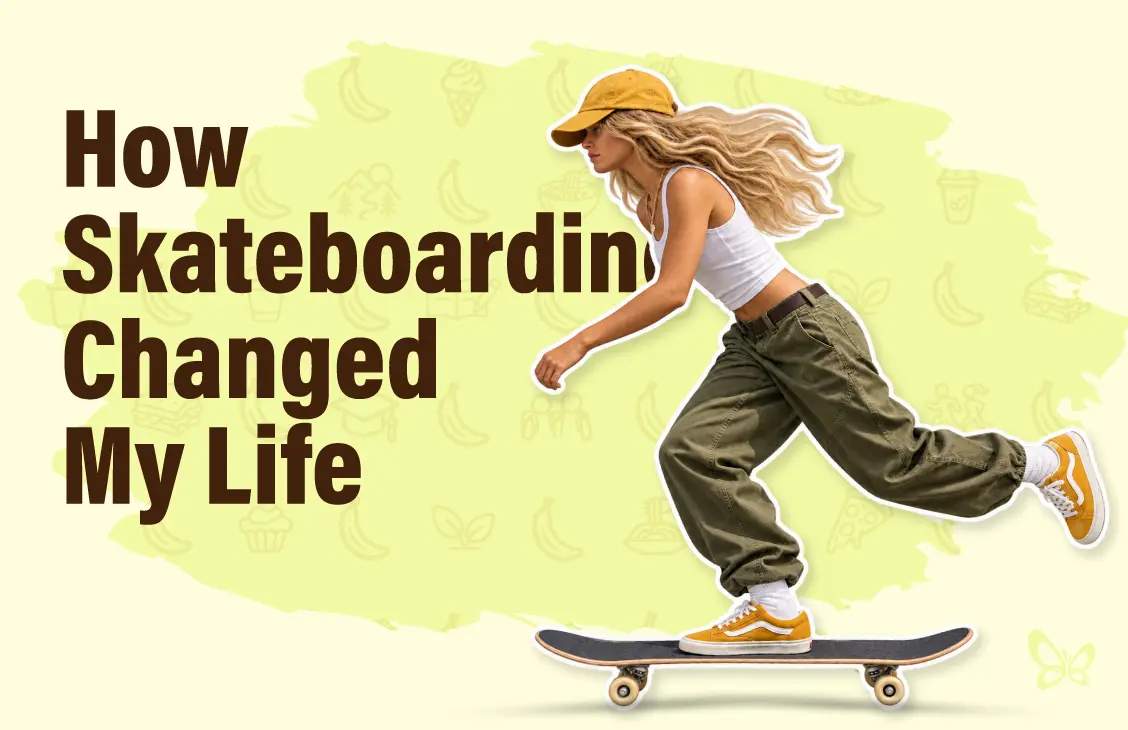
Skateboarding has evolved so much from the rebellious kids getting kicked out of malls in the 80s and 90s to know being a respected Olympic sport. The popularity surely changed with X Games and Tony Hawk’s Pro Skater, bring skateboarding more mainstream.
Skateboarding is one of the hardest things I have ever done. The learning curve is steep. Most able-bodied people can kick a ball into a net, bounce a basketball, or swing a bat or racket. Hockey takes a little more practice, but most sports can be picked up reasonably quickly. Skateboarding, however, is one of the more difficult things to do well. It takes years of practice, scraps, falls, bruises, shin-dings, and overcoming fear.
Progress is slow enough that it can be difficult to tell whether you’re improving at all. You can practice a trick for months or years and still barely land it. You can finally figure it out one afternoon and then come back a few days later and seemingly lose it again.
For all these reasons, it is extremely tempting to quit and do something else. But, if you stick with it, it’ll teach you some valuable life lessons.
It taught me how to be terrible at something for a long time
The biggest lesson that skateboarding taught me was how to be terrible at something for a long time. Standing on the board feels strange, you’re using muscles for balance that you’ve never used before. Movements that look completely natural when someone else does them feel almost impossible when you try them yourself. The second you step on the board, everyone at the skatepark can immediately tell your skill level, and that can be incredibly vulnerable and humbling.
The board also gives you immediate feedback, you either land the trick or you don’t. Partial makes don’t count, sketchy landings are not celebrated, style matters, as does speed.
A proficient skateboarder can effortlessly pop their board off the ground, flip the board, and land back on it, while continue to move. The whole thing might take two seconds. What you don’t see are the countless hours and the hundreds or thousands of failed attempts that came before it. The small adjustments in foot position, timing and balance, the falls, banging the board against your shins, broken wrists, concussions, and the frustration on days when nothing seems to be working.
Progress is often happening before you can see it
Skateboarding changed the way I think about improvement. Most of us like progress that’s obvious and ideally comes relatively quickly. We want to see the number go up, cross something off a list or reach some recognizable milestone that confirms our effort is working. Skateboarding rarely gives you that satisfaction on schedule.
Sometimes improvement consists of getting slightly closer. You stayed over the board this time. Your foot landed in roughly the right place. You committed a little more than yesterday. None of this looks especially impressive, and sometimes you finish a session without landing the thing you were working on at all. Yet something is happening.
Your balance is improving, your timing is changing, movements are slowly becoming instinctive (muscle memory). Your brain and body are learning even when you don’t have much evidence to show for it. Then one day you land something that once seemed impossible. With more practice, you can begin to land it more consistently, with a higher degree of confidence. Then you need to do it a thousand more times with more speed, over obstacles and gaps, linking it with other tricks, while riding backward, switching from your conventional stance to your opposite stance (similar to writing with your opposite hand).
There are plenty of things in life where progress works the same way. Learning a language, building a business, getting stronger, becoming a better writer, developing a friendship or learning almost any difficult skill rarely produces a dramatic improvement every week.
Sometimes you have to tolerate surprisingly long periods where effort and results seem badly mismatched. Skateboarding taught me to trust that period more than I used to.
Failure becomes part of the process
Skateboarding has given me a relationship with failure because failing is what you spend most of your time doing. If you’re learning something difficult, you might fail hundreds of times before you succeed once. After a while, the failure itself becomes less interesting. You pay attention to what happened instead. Micro adjustments are made. Each failure becomes a small piece of the puzzle that you learn what not to do next time. More weight on the back foot, more speed, pop faster, move my foot placement forward and back by one centimeter, commit more. Try again. You have to dismiss judgement, dismiss fatigue, dismiss doubt, dismiss pain. Try again. And again. And again.
There isn’t much time to sit around interpreting every failed attempt as evidence about your ability or your potential. Failure becomes information. That sounds simple, but it is a surprisingly useful thing to experience repeatedly.
Many parts of adult life give failure far more emotional weight. We worry about looking incompetent, making the wrong decision or discovering that we are not as capable as we hoped. Sometimes that fear prevents us from attempting something at all.
Skateboarding makes failure so routine that eventually it loses some of its power. You fall down, work out what happened, and try again.
Camaraderie and community are built in
Since skateboarding is so difficult, membership in the community is earned. With that comes respect. If you are genuinely trying (aka you’re not a poser), then your smallest achievement will often be celebrated by other skaters who are complete strangers. As mentioned, your skill level is always on display from the second you show up with a skateboard. Even the way you carry the board, how you dress, your shoes… are all immediate signals of what level you’re at. There’s no hiding. You earn your place in the community.
Anyone who has skateboarded seriously understands how difficult it is. When you watch someone land a trick, you understand the effort and talent behind it. You know what it feels like to spend weeks trying to land something. The falls, the injuries, the destroyed shoes, the frustration, and the endless repetition. That creates a mutual respect. High-fives, fist bumps, board slaps, and “yeah dudes!” become the default language.
Over time, you also learn the culture. The etiquette of a skatepark, the language, the spots, the history, the way people encourage one another. At some point, without any announcement, you stop being someone who’s trying skateboarding, and you become a skateboarder. It consumes your identity and takes over your life.
There’s something deeply satisfying about communities where belonging requires a little effort. Modern life gives us plenty of groups we can join instantly, but they are different from communities built around participation. When people have practiced together, suffered together, learned together or repeatedly shown up for the same thing, belonging carries a little more weight.
Skateboarding Gave Me Confidence
The strange thing about skateboarding is that for something so difficult, painful and occasionally infuriating, it has given me an enormous amount of confidence.
There have been injuries, countless hours spent trying tricks I never landed, days when I felt like I was getting worse instead of better, and probably an unreasonable amount of money spent replacing shoes that were destroyed within weeks. I have slammed into concrete more times than I can count. There have been plenty of moments when quitting would have been the perfectly rational decision.
But I kept coming back. Over the years, skateboarding changed the way I think about progress, failure and what it means to become genuinely good at something. It taught me that improvement can happen so slowly that you barely notice it, that frustration doesn’t necessarily mean you’re doing something wrong, and that there is a particular satisfaction that comes from earning an ability that nobody can give you and nobody can fake.
It also gave me a culture that I became part of rather than simply observed. Even when I wasn’t skating, skateboarding had changed what I paid attention to. And after enough years, it becomes difficult to separate the activity from the person you became while doing it.