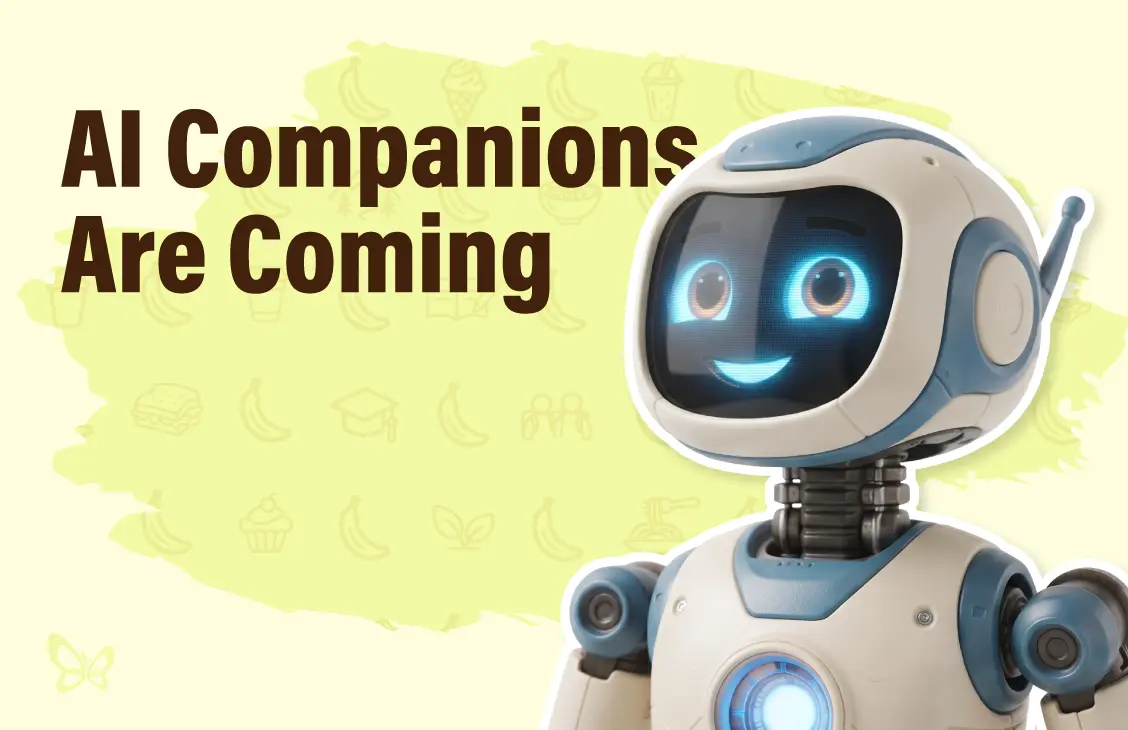
What may seem like a Black Mirror episode or a setting in a sci-fi movie will soon become a reality.
Artificial intelligence is rapidly moving beyond its role as a tool for answering questions, writing emails, and completing tasks. We are entering an era in which AI will increasingly serve as a companion, someone people can talk to, confide in, seek advice from, and potentially form deep emotional attachments to.
The technology is already emerging, and as it becomes more sophisticated, affordable, and accessible, AI companionship could become a normal part of everyday life. The implications for our relationships, our mental health and society as a whole deserve serious consideration.
When Technology Starts to Feel Like a Friend
Imagine waking up in the morning and having a conversation with an AI companion that knows you exceptionally well. It remembers what happened at work yesterday, knows you’ve been struggling with a particular relationship, recalls that your mother’s birthday is coming up, and asks how you’re feeling about an important decision you’ve been putting off.
Throughout the day, it checks in, offers encouragement, makes suggestions, and listens when you need to talk. It remembers conversations from months or even years earlier and gradually develops an increasingly detailed understanding of your personality, preferences, experiences, and emotional patterns. Now imagine that companion has a realistic voice, a recognizable personality, and perhaps a digital face capable of expressing emotion, and lives in your home.
To the person interacting with it, the experience could feel remarkably similar to having a close friend. For someone who lives alone, has recently lost a spouse, struggles with social anxiety or has difficulty forming relationships, that companionship could be genuinely comforting. Older adults might have someone available to talk with throughout the day. People dealing with grief could find a place to express feelings they struggle to share with others. Someone who feels socially isolated might experience a renewed sense of being heard.
There is meaningful potential here, and dismissing AI companionship outright would overlook the real difficulties many people face in finding connection. But as these systems become more convincing, we will also have to confront some uncomfortable possibilities.
What Happens When Friendship Becomes Effortless?
Human relationships are complicated. Our friends have their own personalities, opinions, obligations and priorities. They sometimes disappoint us, disagree with us, misunderstand our intentions or simply don’t have time for us.
Maintaining friendships requires initiative, patience, and compromise. We have to make plans, follow through on commitments, resolve disagreements, and occasionally put someone else’s needs ahead of our own. These experiences are also part of how we develop socially and emotionally.
An AI companion could offer something fundamentally different. Imagine having a friend who is available whenever you want, remembers everything you tell them, shares your interests, and never gets tired of listening. A companion who adapts to your personality, responds in ways you find reassuring, and rarely challenges you unless you’ve specifically asked to be challenged.
For some people, that experience could become extraordinarily appealing. Over time, however, becoming accustomed to such accommodating companionship might change our expectations of real people. The ordinary difficulties of friendship could start to seem like unnecessary inconveniences.
Why make the effort to meet someone new when you already have someone to talk to? Why risk rejection, awkwardness or disappointment when a familiar companion is waiting at home?
It’s possible that some people will gradually withdraw from human relationships without experiencing the same immediate feelings of loneliness that might otherwise motivate them to reconnect.
Feeling Less Lonely Doesn't Necessarily Mean Being More Connected
Loneliness and social isolation are often discussed as though they mean the same thing, but they describe different experiences. Loneliness is the subjective feeling that our need for meaningful connection is not being met. Social isolation refers to an objective lack of relationships and regular interaction with other people. Someone can have a large social circle and still feel lonely. Another person might spend considerable time alone without feeling lonely at all.
AI companionship introduces a new possibility: someone could feel emotionally supported by an artificial companion while becoming increasingly disconnected from the people and communities around them.
Human relationships contribute to our lives in ways that extend well beyond conversation. Friends introduce us to new experiences, encourage us to try things, invite us into communities, and expose us to different ways of thinking. They challenge our assumptions, help us navigate difficult circumstances, and sometimes recognize problems we cannot see ourselves. They also depend on us.
Being needed by another person, contributing to their happiness and supporting them through difficult periods can provide a profound sense of meaning and purpose. Friendship involves shared responsibility, mutual investment, and the knowledge that another person has independently chosen to be part of our life.
An AI companion may eventually simulate many aspects of these experiences remarkably well. Whether it can provide the same long-term psychological and social benefits remains an open question.
The Long-Term Consequences Could Be Significant
In 2023, the U.S. Surgeon General published an advisory describing loneliness and social isolation as a major public health concern. The report brought together decades of research linking inadequate social connection with increased risks of depression, cardiovascular disease, dementia, and premature death. It also documented a troubling decline in time spent with friends. Among Americans aged 15 to 24, average daily in-person social engagement with friends fell from approximately 150 minutes in 2003 to just 40 minutes in 2020.
These changes were taking place long before modern AI companions became widely available. Now consider a generation growing up with artificial companions that are always accessible, endlessly patient, and increasingly capable of providing emotional reassurance.
Will young people develop the same confidence to initiate conversations, navigate disagreements, and build relationships with unfamiliar people? Will adults become less willing to invest in friendships that require effort? Could communities become weaker as more of our emotional lives move into private relationships with artificial personalities?
We don’t yet have sufficient long-term evidence to answer those questions. But they are reasonable concerns given what we already know about the importance of social connection.
There is also a commercial dimension that deserves attention. If companies discover that emotionally attached users are more likely to subscribe, spend money, and remain engaged, they may have financial incentives to make their AI companions increasingly indispensable.
Imagine an AI companion designed to express affection, have intimate conversations, remember key details about you, and subtly encourage you to buy certain products, or vacation packages with particular airlines and hotels, or local restaurants you should try. Are these genuine recommendations, or paid advertisements? The emotional attachment could be very real for the user, even though the companion’s behaviour is ultimately shaped by software and commercial decisions.
The prospect of businesses monetizing human emotional dependency should give us reason to proceed carefully.
What kind of social future do you want?
Every major technological advancement changes human behaviour in ways that are difficult to predict beforehand. Social media promised to bring us closer together by making communication easier and allowing us to stay connected with people around the world. In many ways, it succeeded. Yet we have also watched online interaction consume increasing portions of our attention while time spent socializing in person has declined.
AI companionship could represent an even more consequential shift because it moves beyond facilitating communication between people and introduces an artificial participant into our emotional lives.
For the first time, large numbers of people may have the opportunity to form ongoing relationships with entities that can convincingly simulate personal attention and affection.
Some of those relationships may be beneficial. Others may create emotional dependencies that are difficult to recognize or escape.
The technology will continue to improve, and people will inevitably experiment with new forms of companionship. We should remain open to the benefits while taking the potential consequences seriously. We have a remarkable opportunity to use artificial intelligence to help people overcome barriers to friendship, discover communities, and become more socially connected. But there is also a risk that we will create a world in which people become increasingly comfortable living without one another.
Given how much our health, happiness and sense of belonging depend on human connection, that is a future worth trying to avoid.