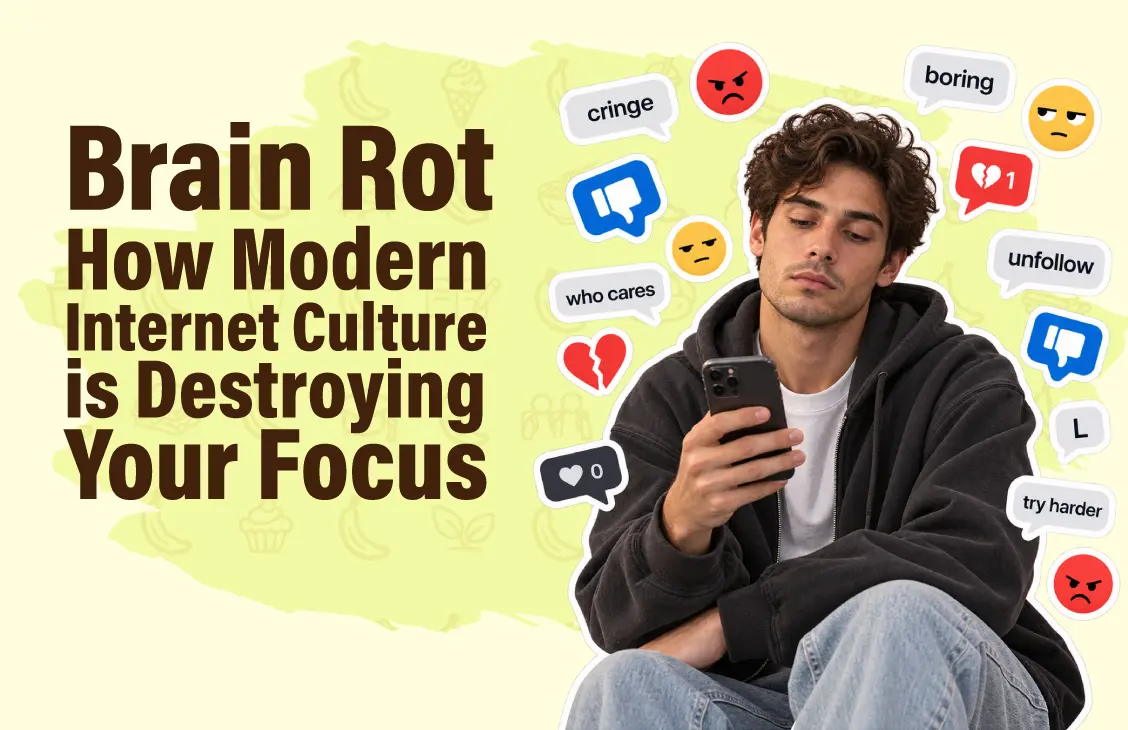
Brain rot is not new
‘Brain rot’ sounds like something invented on TikTok, but it actually dates back more than 170 years.
Henry David Thoreau used the term in Walden in 1854 while complaining about society’s preference for simple ideas over more complicated ones. In 2024, Oxford named brain rot its Word of the Year, defining it as a perceived deterioration in someone’s mental or intellectual state associated with consuming too much trivial or unchallenging content. Use of the term had increased 230% in a single year.
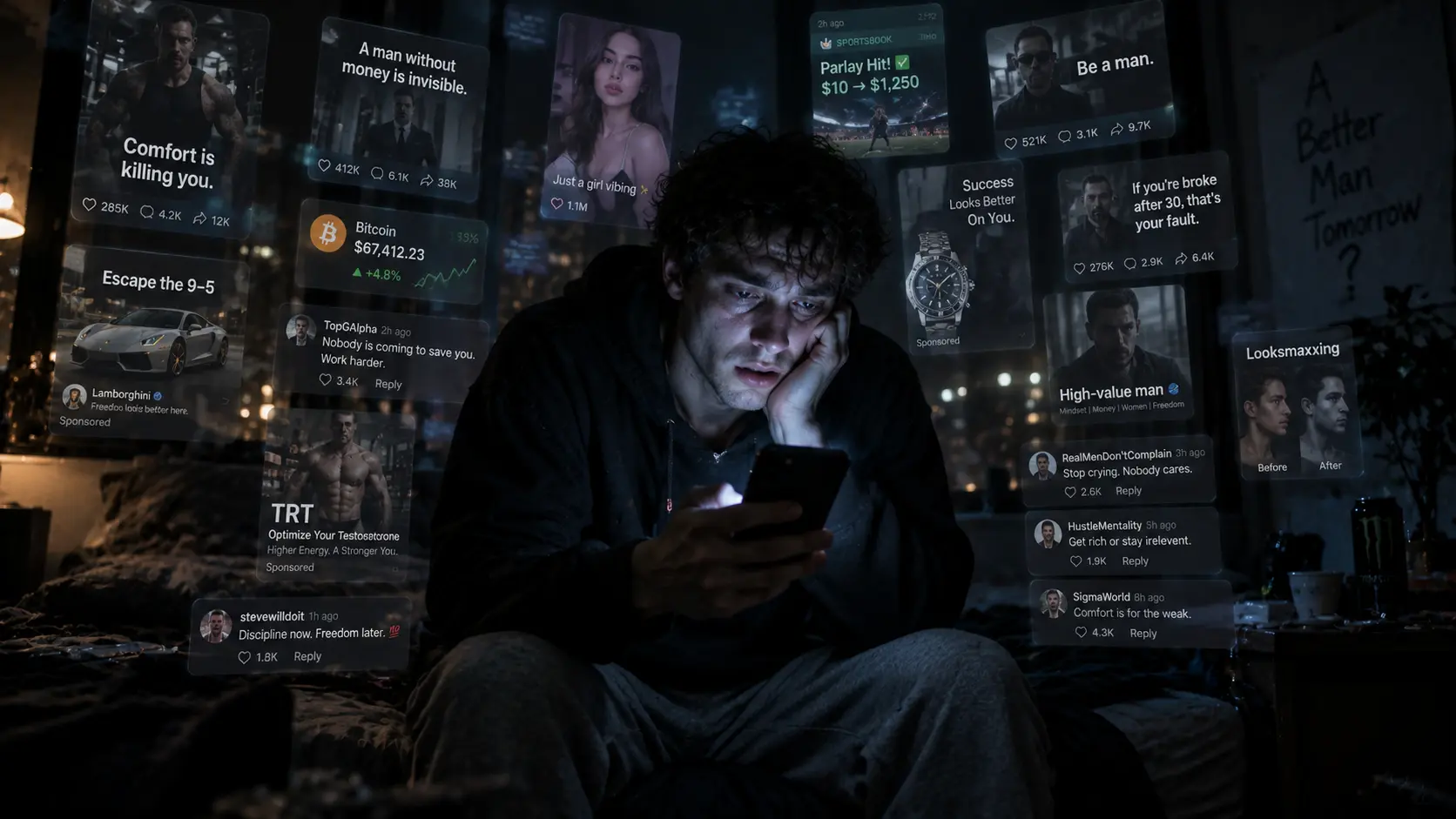
The modern version is familiar. You pick up your phone to check one thing, and then an hour later, you’ve watched a dog fall off a couch, somebody explain why seed oils are destroying civilization, an argument between strangers, something about crypto, three celebrity-endorsed ads, a man explaining the importance of masculinity, a recipe you’ll never make, and dozens of other videos you immediately scrolled past.
You weren’t exactly entertained, nor did you learn anything. So why are you still consuming?
Our attention is being chopped into smaller pieces
“Our attention spans are declining, averaging just 47 seconds on any screen.” — Gloria Mark, a professor emerita at the University of California, Irvine. She has spent more than two decades studying how people pay attention while using technology. In her early research, she found people spent an average of roughly two and a half minutes on one screen before switching. However, by the late 2010s and around 2020, that average had fallen to about 47 seconds.
There’s an important distinction here. This does not mean humans now possess a universal 47-second attention span. The research measures how long people stay with content on a screen before switching. Someone can still read a novel for an hour, watch a movie or become completely absorbed in a project.
What appears to have changed is our behaviour around digital information. We switch, a lot, and every switch comes with a cost.
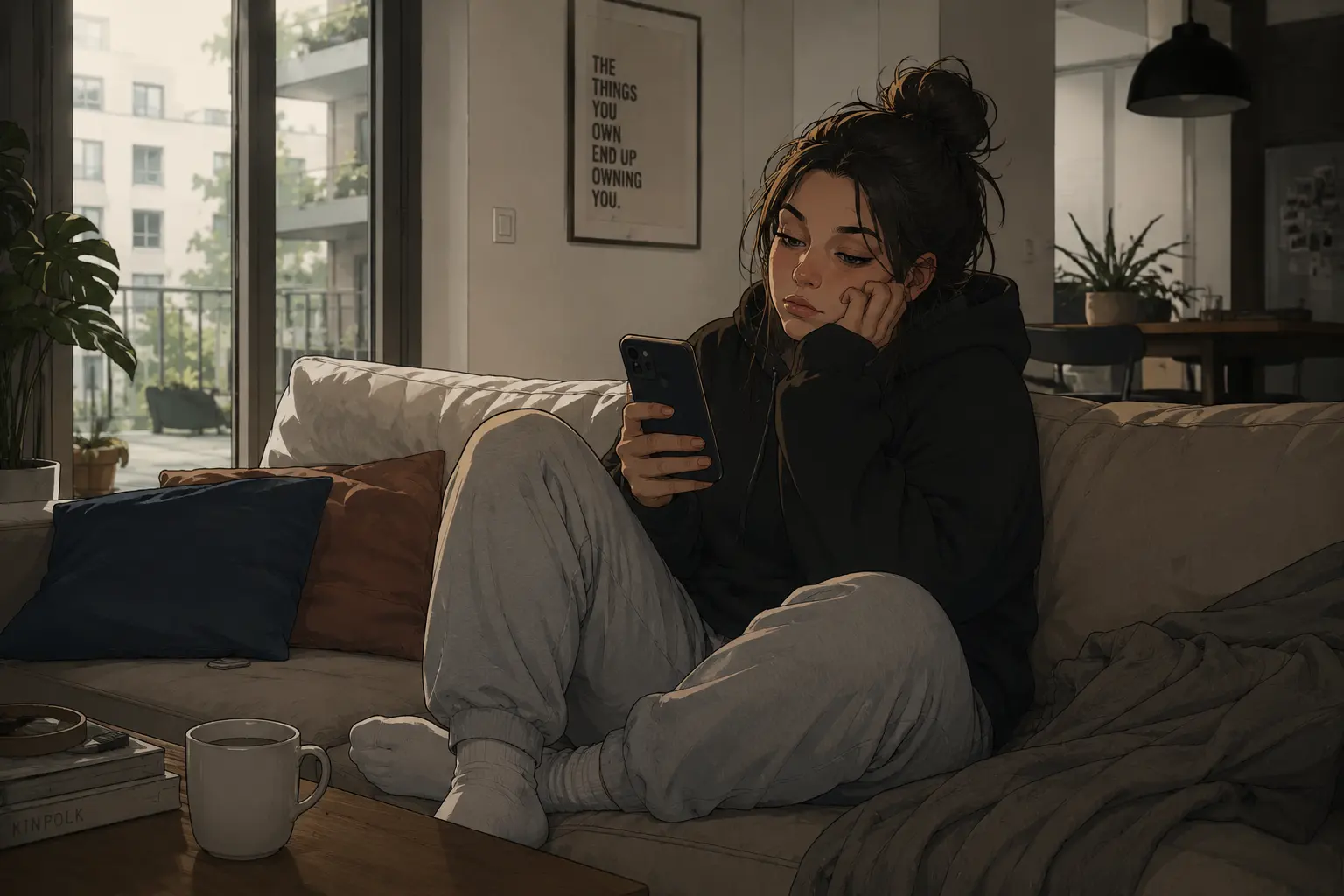
Research on media multitasking has repeatedly found associations with attentional failures and difficulty filtering irrelevant information. More recent experimental research has begun looking specifically at short-form video.
One 2025 experiment found that after 30 minutes of TikTok-style videos, participants showed poorer preparation when switching between cognitive tasks than people who had watched a documentary or no video at all. The study was small, so it should be treated as preliminary, but it gives researchers a mechanism worth investigating.
How does screen time affect our youth?
In the U.S., 36% of teenagers reported in 2025 that they use at least one of five major social platforms almost constantly. Canadian data are similarly striking. In the 2022 Health Behaviour in School-aged Children study, 89% to 96% of students in Grades 6 through 10 exceeded the recommended maximum of two hours of recreational screen time per day. Average screen time was roughly 4.5 to 5.5 hours a day.
Even very young children are entering this environment. A 2025 Common Sense Media study found that 40% of children had a tablet by age two, and nearly one-quarter had their own cellphone by age eight. Short-form video use among young children was also increasing.
That does not mean screens are inherently bad for children. Video calls with grandparents, educational programs, creative tools, games played with friends and mindlessly scrolling an infinite video feed are all “screen time,” but they are obviously not the same experience.
The American Psychological Association makes this distinction explicitly, “Social media is neither inherently harmful nor beneficial to our youth.” Content, context, age, duration and what screen use replaces all matter.
But the developmental evidence gives us reason to pay attention. A 2026 longitudinal study followed nearly 9,800 children from ages three to nine. Children with persistently high or increasing digital technology use had more peer relationship problems and lower selective-attention and reading outcomes at age nine. Importantly, the researchers described these as correlations, not proof that technology caused those outcomes.
Another longitudinal study of more than 6,000 children found that higher screen exposure in early childhood was associated with poorer later vocabulary, communication, writing, numeracy and peer outcomes. The relationships became smaller after researchers controlled for family and socioeconomic factors, but they did not disappear.
We don't actually know what this looks like 20 years from now
The uncomfortable reality is that the experiment is still underway. TikTok launched internationally in 2017. Instagram Reels arrived in 2020. YouTube Shorts followed soon after. The first generation to spend childhood immersed in algorithmically personalized, endlessly scrolling short-form video has not yet reached middle age.
The APA notes that long-term, multi-year research into social media use remains limited and that long-term outcomes extending into adulthood are still largely unknown. So claims that we already know these platforms will permanently damage an entire generation go beyond the evidence.
We are giving developing minds access to a system capable of providing virtually unlimited novelty, personalized by algorithms that learn what keeps each person watching. It seems reasonable to be deliberate about how much of childhood we hand over to it.
Mental health is part of the picture too
The U.S. Surgeon General’s advisory found that adolescents spending more than three hours per day on social media faced roughly double the risk of symptoms of depression and anxiety in the studies it reviewed. The advisory also stressed that available evidence does not establish that social media is the sole cause.
A 2025 Public Health Agency of Canada study involving nearly 27,000 children and youth found that those meeting the recommendation of two hours or less of recreational screen time generally reported better measures of happiness, life satisfaction and mental health, though associations differed by age and sex.
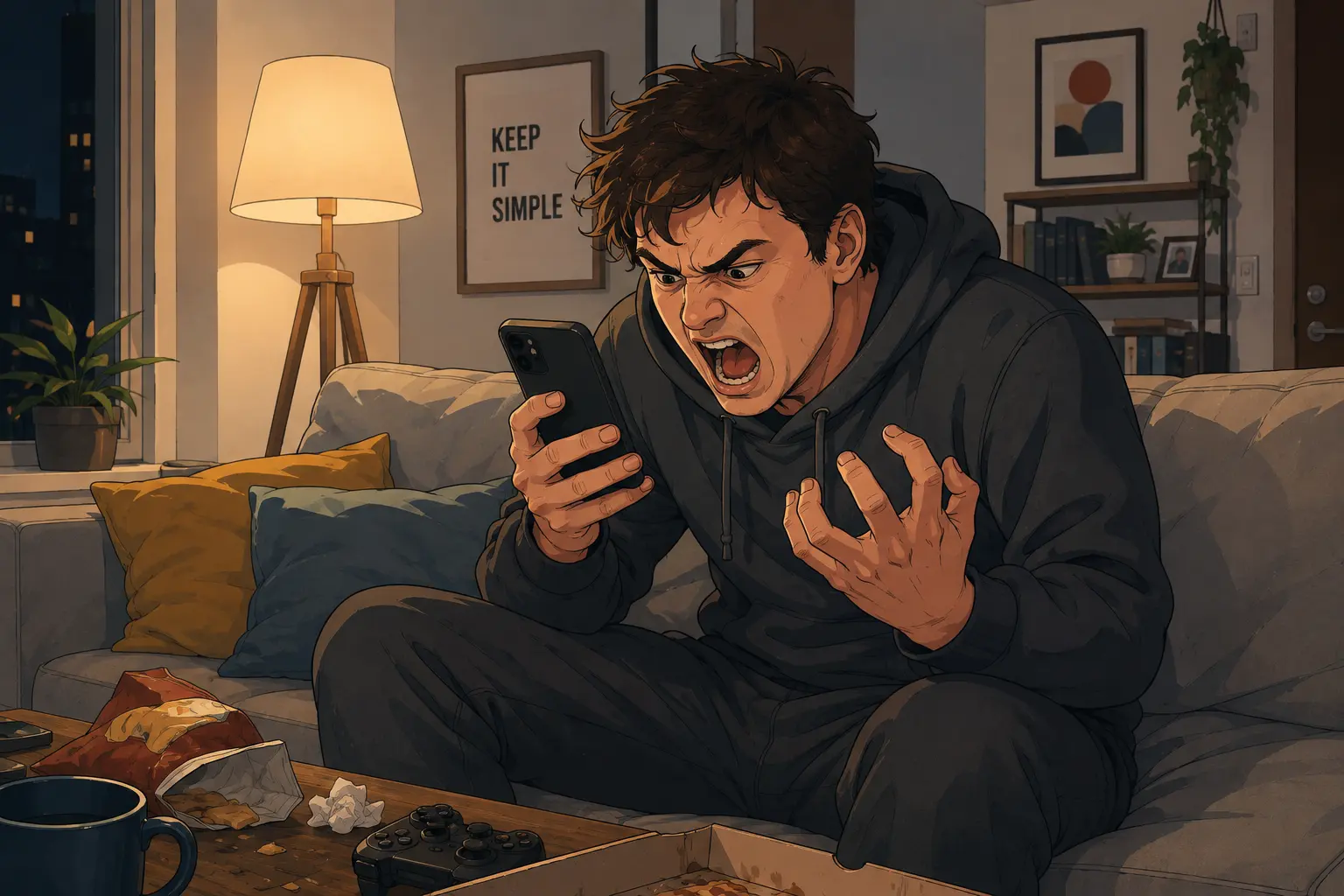
Sleep may be one of the less mysterious pathways. Social media use, especially around bedtime, is associated with sleep disruption, and insufficient sleep itself affects mood, cognition and development.
So what do we do?
We can all likely agree that technology has a lot of benefits. So the problem is not simply that we use screens. The problem is when consumption becomes compulsive. Depending on how it is measured, studies have found that people unlock or check their phones hundreds of times a day. One recent U.S. survey put the figure at 205 checks a day, roughly once every five waking minutes.
There are some fairly unglamorous ways to push back:
- Make endless feeds something you choose to enter, rather than the default response to every empty moment.
- Remove the most compulsive apps from your home screen.
- Turn off unnecessary notifications and create small amounts of friction before opening them.
- Protect sleep. The Canadian Paediatric Society recommends avoiding screens for at least an hour before bed and keeping recreational screens out of children’s bedrooms.
- Give children opportunities to practice sustained attention away from screens. Reading, drawing, building things, sports, music and unstructured play all ask the brain to remain with an activity longer than the next swipe.
- Pay attention to content, not only minutes. Thirty minutes spent FaceTiming a grandparent or friend is different from thirty minutes of appearance comparison or outrage videos.
- Create screen-free spaces where people are expected to be present with one another (i.e. meals, walks, conversations and time with friends).
- Occasionally allow yourself to be bored. You do not have to eliminate every five-second pocket of nothingness.
For parents, the research increasingly supports involvement rather than simply confiscation. Discuss what children are watching, teach them how recommendation algorithms work, set limits together and model the behaviour you expect from them. The APA recommends this combination of boundaries, monitoring, and ongoing discussion, particularly in early adolescence.
Maybe we need a little less content and a little more life
The internet was supposed to connect us, and in many ways it has. But connection and consumption are not the same thing.
We can spend hours seeing other people’s faces without speaking to anyone. We can know what thousands of strangers think while knowing very little about the person living three doors down. We can consume more information before breakfast than previous generations encountered in days and somehow finish feeling as though nothing happened.
The behaviours we associate with brain rot are real, so how do we push back against them? The answer may not be abandoning technology. Perhaps it’s becoming more demanding about what we expect technology to do for us. Help us learn something. Help us make something. Help us find somebody. Help us make a plan. And then, every once in a while, help us put the phone down.