What do the Teenage Mutant Ninja Turtles teach us about psychology?
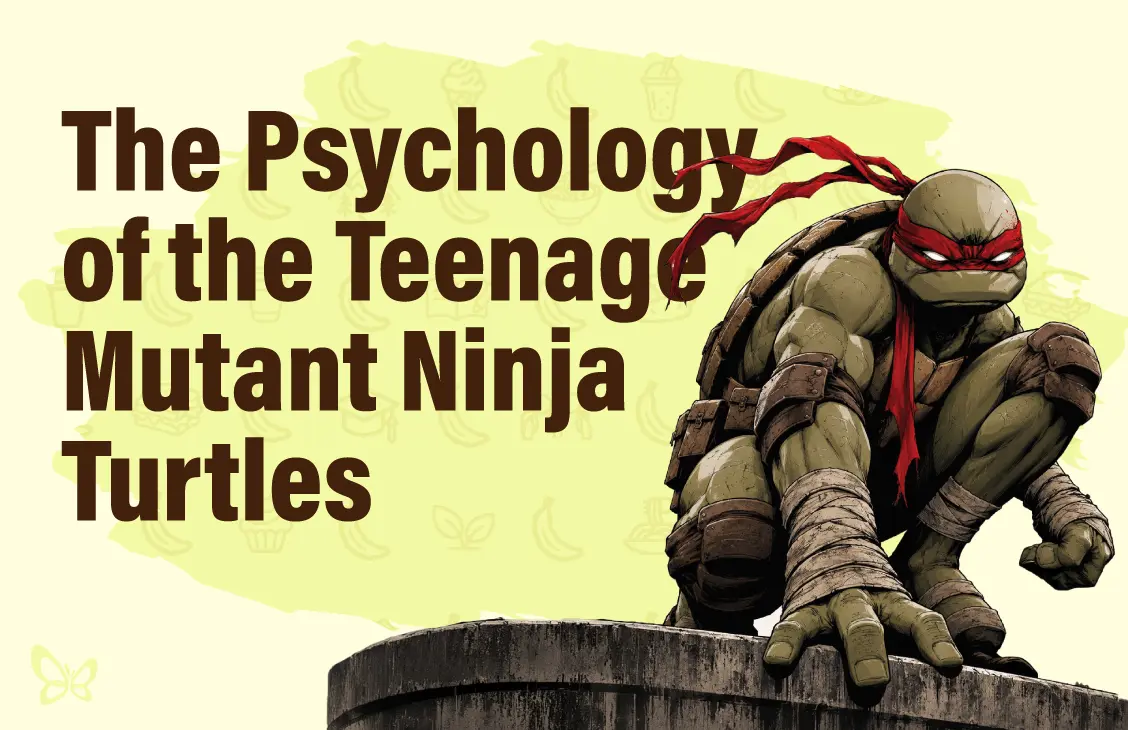
Leonardo, Raphael, Donatello, and Michelangelo are four mutant brothers living in a sewer, eating pizza, and fighting crime. Their personalities were exaggerated because that made them easy to distinguish. Leonardo was responsible. Raphael was angry. Donatello was intelligent. Michelangelo was playful.
That simplicity is part of what makes them interesting as adults.
There is a Jungian-influenced framework of masculine psychology, popularized by Robert Moore and Douglas Gillette, that describes four recurring archetypes: the King, the Warrior, the Magician, and the Lover. The Turtles line up remarkably well. Leonardo resembles the King. Raphael carries the Warrior. Donatello fits the Magician. Michelangelo represents the Lover. Once you see them that way, the group becomes more interesting than four colourful personalities.
Leonardo and the King
Leonardo is usually treated as the boring Turtle. He follows Splinter’s teachings, thinks about the mission, worries about the consequences of everyone’s decisions, and carries responsibility for the group. While Michelangelo is having fun and Raphael is charging into a fight, Leonardo is usually trying to keep everyone moving in the same direction.
The King archetype represents a similar capacity for stewardship. It includes leadership, responsibility, order, and the ability to think beyond your immediate wants.
Plenty of men become good at this. They become dependable sons, husbands, fathers, managers, and friends. When something goes wrong, people call them. When a decision needs to be made, they make it. They organize the trip, pay the bill, solve the problem, and make sure everyone gets home.
There is a great deal of value in being that person. There can also be a cost when responsibility becomes the only mode in which someone knows how to operate.
A man who has spent much of his life managing everything around him may struggle to relax when somebody else is in charge. He can treat leisure as wasted time, find spontaneity irritating, and feel uncomfortable when there is nothing that needs fixing. Even a vacation can become another project to manage.
Sometimes that pattern goes back a long way. The oldest child in an unstable household may learn responsibility much earlier than his friends. A boy with an unreliable parent may discover that being organized and self-sufficient makes life safer. Those behaviours can remain long after the circumstances that required them have disappeared.
Raphael and the Warrior
Raphael is the opposite of Leo. He’s aggressive, impatient, and confrontational. He has little interest in diplomacy when a fight will do. He can also be fiercely loyal and willing to put himself in danger for the people he cares about.
The Warrior archetype is often misunderstood because aggression has such a negative reputation. Healthy aggression has a place in human life. It allows someone to set boundaries, confront problems, compete, protect other people and act decisively when circumstances demand it.
Some men experience disagreement as disrespect. They become disproportionately angry when challenged, search for enemies where there may only be differences of opinion, or remain psychologically prepared for confrontation long after a threat has passed.
For someone raised around instability, bullying or violence, being difficult to intimidate may once have been extremely useful. The same habit carried into a marriage, friendship or workplace can create problems that strength alone cannot solve.
The same man who struggles to tolerate disagreement may also be the first person to step forward when somebody is being mistreated. He may be willing to have difficult conversations that others avoid, defend an unpopular position, or endure hardship without abandoning the people who depend on him.
Donatello and the Magician
Donatello wins with his mind. He builds machines, understands technology, and solves problems the others cannot. He observes before acting and usually knows something his brothers do not.
The Magician archetype represents knowledge, insight, craft, and the ability to understand how things work. It is the engineer, researcher, strategist, teacher, and problem-solver.
A lot of men are very comfortable here. Thinking is useful because it creates distance from messy situations. A problem can be examined, categorized, and worked through. If you can understand something, you may feel as though you can control it. That approach works beautifully with a machine. However, human beings are less cooperative.
You cannot reason your way out of every grief. A partner who is upset may not need an explanation of why the situation occurred. Someone who has been hurt by you may care very little about whether your intentions were logical. There are experiences that have to be felt before they can be understood.
For someone who grew up in a home where emotions were volatile, intelligence can become a refuge. The head feels safer than the heart. The person may later describe himself as “just not very emotional,” even though a great deal of emotion exists underneath the analysis.
Michelangelo and the Lover
Michelangelo jokes around, loves pizza, is easily distracted, and seems less burdened by the seriousness that weighs on Leonardo. He’s also less interested in conflict than Raphael.
Through an archetypal lens, much of that fits the Lover: emotion, pleasure, beauty, connection, play, and the ability to feel fully engaged with life. Those qualities are sometimes treated as optional parts of adulthood, especially for men. Responsibility, productivity, and competence are respectable, whereas play can look childish by comparison.
A man can build a very successful life while becoming strangely unable to enjoy it. He can provide for his family without being particularly present with them. He can work hard for years toward a lifestyle that he rarely has time to experience. He can become excellent at solving everyone else’s problems while having little idea what makes him feel alive.
Michelangelo enjoys people. He jokes because laughter is part of being together. He can become absorbed in simple pleasures such as food, music, flirting, games, and the immediate experience of being alive. Those qualities can become evasive when humour is used to escape every serious conversation or pleasure becomes an excuse to avoid responsibility.
The Psychology of their Weapons
Even the Turtles’ weapons seem unusually well suited to their personalities. Splinter does not simply give four young fighters whatever happens to be available. Each weapon demands something different from the person using it, and viewed through the same psychological lens, the choices almost look like lessons.
Leonardo carries the katana, the most lethal weapon of the four. A sword introduces consequences that a wooden staff does not. That makes it appropriate for the brother who is most disciplined, restrained, and conscious of responsibility. Leonardo can be trusted with greater destructive power because he is the least likely to use it impulsively. In that sense, his weapon reflects the King. Authority comes with the capacity to do harm, but maturity determines whether that power is used wisely.
Raphael’s sai work almost in the opposite direction. Although they can be used offensively, the sai are particularly suited to blocking, trapping, controlling, and disarming an opponent. That is an interesting weapon to place in the hands of the brother most naturally inclined toward aggression. Raphael does not need encouragement to attack. He needs control. His weapons force his aggression into a more disciplined form, turning the Warrior’s instinct to confront into the ability to defend, restrain, and protect.
Donatello receives perhaps the least glamorous weapon, a wooden staff. There is no blade, elaborate mechanism, or obvious intimidation factor. Its effectiveness comes from understanding distance, leverage, timing, balance, and technique. That fits the Magician remarkably well. Donatello’s advantage has never been brute force. He takes something simple and discovers what it can do. In the hands of somebody who understands its mechanics, an ordinary piece of wood becomes extraordinarily versatile. The weapon rewards knowledge.
Michelangelo’s nunchaku may be the most revealing choice of all. They are fast, fluid, rhythmic, unpredictable, and difficult to control without considerable coordination. They look almost playful when used well, which suits the brother most closely associated with movement, humour, spontaneity, and pleasure. Yet nunchaku also punish carelessness. Their freedom of movement requires concentration, timing, and awareness or the weapon can come back toward the person wielding it. For Michelangelo, the weapon allows playfulness while demanding discipline within it.
Seen this way, Splinter’s choices do something more interesting than match four weapons to four personalities. They give each brother a tool that develops something he needs. Leonardo must carry power responsibly. Raphael must learn restraint. Donatello must turn knowledge into action. Michelangelo must bring focus to his freedom.
Michelangelo and The Last Ronin (*Contains Spoilers*)
There is an unexpectedly fitting extension of this idea in Teenage Mutant Ninja Turtles: The Last Ronin.
The story takes place in a future where only one of the four brothers remains: Michelangelo.
The Turtle known for jokes, pizza, and carefree behaviour is left carrying the loss of his brothers and the responsibility that comes with being the survivor. He has to become far more disciplined and formidable than the Michelangelo most people remember from childhood. The character still contains the history of who he was, but he now carries qualities associated with Leonardo, Raphael, and Donatello as well.
That makes the story unusually compelling when viewed through this framework. Michelangelo cannot rely on the role he once occupied within the group because the group is gone. Life requires capacities that used to belong to somebody else.
Becoming All Four Turtles
Most of us have a natural tendency toward one or two of these archetypes. Some people are comfortable taking charge, others are quick to confront a challenge, some prefer to think their way through problems, and others are happiest making people laugh and bringing everyone together. These tendencies often emerge early in life, shaped by temperament, upbringing, and experience. Over time, we become increasingly skilled at playing the roles that come most naturally to us.
The difficulty is that life eventually places us in situations where our preferred approach is inadequate. The responsible person may need to loosen their grip and enjoy themselves. The aggressive person may need to listen rather than confront. The intellectual may need to express an emotion they cannot explain, while the playful person may need to take something seriously when others are depending on them.
This is where the four archetypes become useful as a framework for personal growth. A father might draw on Leonardo’s steadiness when his family needs stability, Raphael’s courage when someone needs protection, Donatello’s intelligence when facing a difficult decision, and Michelangelo’s playfulness when spending an afternoon with his children. Each represents a capacity worth developing, regardless of which comes most naturally.
And for those of us who grew up identifying with one particular Turtle, there is an interesting possibility worth considering: the Turtle we admired most as children may tell us something about who we were, while the other three may reveal something about who we still have the capacity to become.